Winmdi 29 Free Download Software
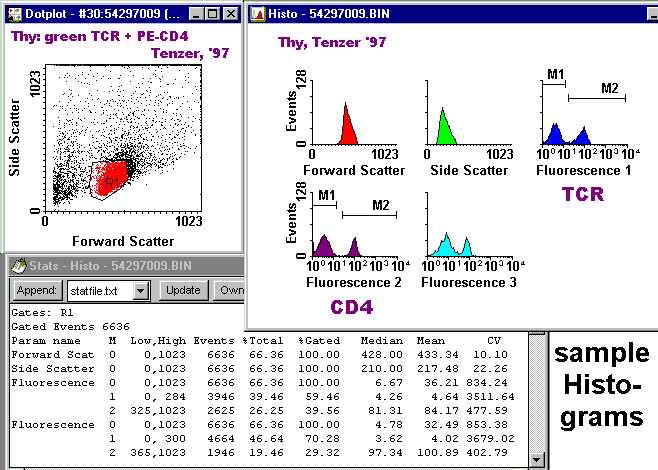
Download Share Share. 29 The Cytomation Mo Flo cell sorter. WinMDI is a free software written by J.Trotter.
Hi, I'm trying to run the program WinMDI 2.9, a free software to display and treat results obtained with flowcytometer but I received a message saying: this app can't run on your PC (the only requirement demanded by the software is to have Windows). I've had already tried the troubleshooting with no success. The program was developed to run with windows interfaces and I can use it in my work with a Win 7 but not in my laptop (Win 8). Can you help? ***Removing personal information for security purposes*** Castro ***Personal information deleted by the moderator. Please see the for more information on how you can protect your privacy.***.
Hi, Thank you for posting your query on Microsoft Community. As per the description, I understand that you are unable to run a program. I would like to know some information. • What troubleshooting steps have you tried? I suggest you to perform clean boot and check, using this Microsoft Article because may be a third party application is causing this issue.
NOTE: A clean boot is performed to start Windows by using a minimal set of drivers and startup programs. This helps eliminate software conflicts that occur when you install a program or an update or when you run a program in Windows. You may also troubleshoot or determine what conflict is causing the problem by performing a clean boot. You must log on to the computer as an administrator to be able to perform a clean boot. Your computer may temporarily lose some functionality when you perform a clean boot. When you start the computer normally, the functionality returns. However, you may receive the original error message, or experience the original behavior if the problem still exists.
If the computer is connected to a network, network policy settings may prevent you from following these steps. Once you perform clean boot do refer to the section “ How to reset the computer to start normally after clean boot troubleshooting” to boot the computer in normal mode. I would suggest you to try installing the program in Windows 7 compatibility mode and check if it works for you.
 Make older programs compatible with this version of Windows: Hope this information helps. Please let us know if you need any other assistance with Windows in future. We will be happy to assist you.
Flow cytometry bioinformatics is the application of to data, which involves storing, retrieving, organizing, and analyzing flow cytometry data using extensive computational resources and tools. Flow cytometry bioinformatics requires extensive use of and contributes to the development of techniques from. Flow cytometry and related methods allow the quantification of multiple independent on large numbers of single. The rapid growth in the multidimensionality and throughput of flow cytometry data, particularly in the 2000s, has led to the creation of a variety of computational analysis methods, data standards, and public databases for the sharing of results. Computational methods exist to assist in the preprocessing of flow cytometry data, identifying cell populations within it, matching those cell populations across samples, and performing diagnosis and discovery using the results of previous steps. For preprocessing, this includes compensating for spectral overlap, data onto scales conducive to visualization and analysis, assessing data for quality, and data across samples and experiments.
For population identification, tools are available to aid traditional manual identification of populations in two-dimensional (gating), to use to aid gating, and to find populations automatically in higher dimensional space in a variety of ways. It is also possible to characterize data in more comprehensive ways, such as the density-guided technique known as probability binning, or by combinatorial gating. Finally, diagnosis using flow cytometry data can be aided by techniques, and discovery of new cell types of biological importance by high-throughput statistical methods, as part of pipelines incorporating all of the aforementioned methods.,, and are also key parts of flow cytometry bioinformatics. Data standards include the widely adopted Flow Cytometry Standard (FCS) defining how data from cytometers should be stored, but also several new standards under development by the International Society for Advancement of Cytometry (ISAC) to aid in storing more detailed information about experimental design and analytical steps. Open data is slowly growing with the opening of the CytoBank database in 2010 and FlowRepository in 2012, both of which allow users to freely distribute their data, and the latter of which has been recommended as the preferred repository for MIFlowCyt-compliant data by ISAC.
Open software is most widely available in the form of a suite of packages, but is also available for web execution on the platform. Measuring length Until the early 2000s, flow cytometry could only measure a few fluorescent markers at a time. Through the late 1990s into the mid-2000s, however, rapid development of new fluorophores resulted in modern instruments capable of quantifying up to 18 markers per cell. More recently, the new technology of mass cytometry replaces fluorophores with detected by, achieving the ability to measure the expression of 34 or more markers. At the same time, methods are providing a flow cytometry–like method of quantifying 48 or more RNA molecules per cell. The rapid increase in the dimensionality of flow cytometry data coupled with the development of high-throughput robotic platforms capable of assaying hundreds to thousands of samples automatically have created a need for improved computational analysis methods.